Parents’ evening usually gives you about ten minutes. If you’ve been worried about your child, that can feel like nowhere near enough. It isn’t meant to be. The SEND Code of Practice says conversations about a child’s special educational needs “will, however, be longer than most parent-teacher meetings”. So don’t aim to sort everything out in ten minutes. Aim to say clearly what you’ve noticed, hear what school has seen, and leave with a date for a proper conversation.
The minimum number of times a year the SEND Code of Practice says schools should meet parents of a child receiving SEN Support (para 6.65).
Before you go
- Write down three things you’ve noticed, with an example of each. “He’s struggling” is easy to agree with and move past. “He cries over spelling homework most nights, and can’t tell me what he did at school” gives the teacher something specific to respond to.
- Ask your child what they find hard. Keep it light: “What would you want your teacher to know?” The Code of Practice says the pupil’s own views should be part of these discussions.
- Check the school’s SEN Information Report. Every state-funded school must publish one on its website. It names the SENCO, with contact details, and explains how the school involves parents.
- Decide your one main ask. If time runs out, this is the thing you must say.
Six questions to ask
- How is my child doing compared with where you’d expect them to be? Not just “fine”, but whether they’re making the progress expected for their age.
- What have you noticed about how they learn, concentrate or get on with others?
- Is anything already being done differently for them? Extra help, a group, changes in class.
- Do you think they might have special educational needs? Has the SENCO been involved?
- What happens next, and when will we review it? The Code of Practice says a clear date for reviewing progress should be agreed.
- Can we book a longer meeting with you and the SENCO? This is often the most useful thing you’ll leave with.
If school says they’re fine
It’s one of the most common things parents hear, and it’s not a reason to stop. Stay calm and specific:
- Share your examples, and ask what they’d expect to see in class if there were a difficulty.
- Ask for your concerns to be recorded. It’s a reasonable request, and it matters later.
- Ask for the longer meeting with the SENCO rather than trying to settle it there and then.
Before you leave
Agree one next step, who’s doing it, and by when. Even “the SENCO will contact you by Friday 13 November” is better than “we’ll keep an eye on it”.
Not sure whether what you’re seeing at home points to something more? A free 15-minute call is a good place to start.
Book a Free 15-Minute CallAfter parents’ evening
- Write it down the same evening. What you raised, what the teacher said, and what was agreed.
- Send a short email within 48 hours. Thank the teacher, and confirm what you discussed and what was agreed. The question card has a three-line email you can copy.
- If you asked for a meeting with the SENCO, put the request in writing. Our free letter template does it for you.
- If your child is on SEN Support, expect more than parents’ evening. Schools should meet you at least three times a year, and give you a record of what’s been agreed.
- Look out for the school’s inclusion strategy. Every maintained school and academy must publish one by 31 December 2026, setting out the barriers its pupils face and what it’s doing about them. It’s a useful thing to ask about.
- Get free, independent advice if you need it. In Kent, IASK (Information, Advice and Support Kent) can help on 03000 41 3000.
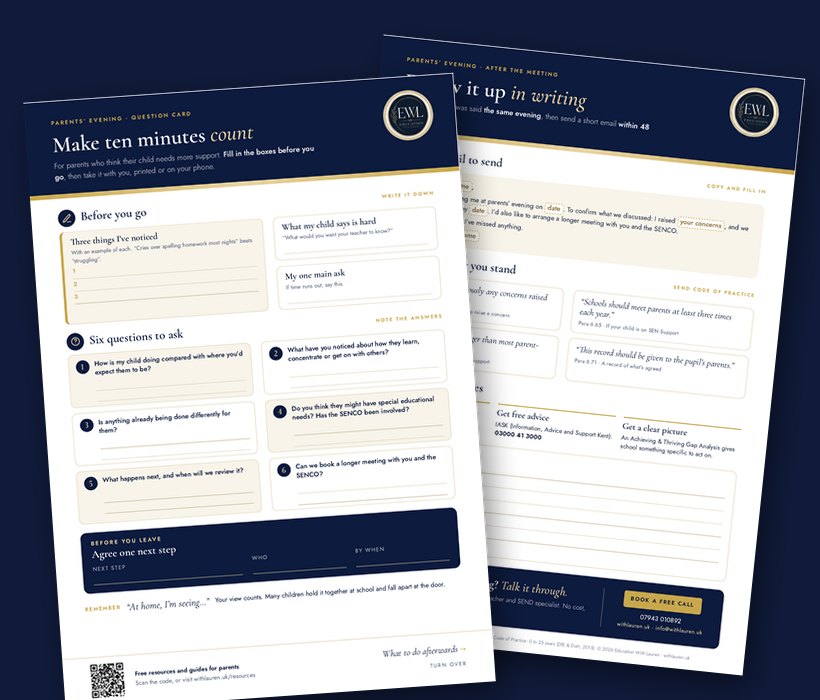
Make ten minutes count
Two pages to print or keep on your phone: what to note before you go, the six questions with space for answers, the email to send afterwards, and where you stand.
Where Education With Lauren fits in
Parents’ evening tells you what school sees. Sometimes you need a clearer picture of why your child is struggling, in a form school can act on.
- Achieving & Thriving Gap Analysis — an independent picture of your child’s attainment, learning gaps, processing and barriers to learning, with indicators of SEND. You come away knowing what to ask school for.
- Achieving & Thriving Gap Analysis with School Liaison Service — everything in the Gap Analysis, plus a provision map the class teacher and SENCO can act on straight away.
- Free resources — the letter template and the question card, for parents who want to start the conversation themselves.
“…I now feel like I have a much clearer understanding if what will help her achieve, and also know what I need to be discussing with school in terms of appropriate support…”
“…not only did she spot things that were constantly being brushed off as “normal” She listened to me as a parent…”
You don’t have to fix it in ten minutes. You just have to start the conversation, and get the next one booked.

Lauren is the founder of Education With Lauren, a qualified teacher and SEND specialist with 16 years’ experience across mainstream schools, Kent County Council provisions and specialist settings. She holds a BA (Hons) in Primary Education with QTS (SpLD, Needs and Inclusion) and an MSc in Neuroscience and Brain Cognition, and is an approved education supplier to Kent County Council.
Frequently asked questions
Can I ask for a longer meeting than parents’ evening?
Yes. The SEND Code of Practice says conversations about a child’s special educational needs will be longer than most parent-teacher meetings. Ask for a separate meeting with your child’s teacher and the SENCO.
Do I need a diagnosis to raise concerns about my child?
No. The SEND Code of Practice says schools should take seriously any concerns raised by a parent, and record them alongside the school’s own assessment.
How often should school meet me if my child is on SEN Support?
The SEND Code of Practice says schools should meet parents at least three times a year, and give parents a record of the outcomes, actions and support agreed.
How do I find out who the SENCO is?
Every state-funded school must publish an SEN Information Report on its website. In mainstream schools, it must include the SENCO’s name and contact details.
What if the teacher says my child is fine?
Share specific examples of what you see at home, ask for your concerns to be recorded, and ask for a meeting with the SENCO. Free, independent advice is available from IASK in Kent.
This article is general information for parents. It is not legal advice.
Sources
- Department for Education & Department of Health, SEND Code of Practice: 0 to 25 years (2015), paras 6.17, 6.20, 6.39, 6.43, 6.45, 6.65, 6.69, 6.70, 6.71 and 6.79
- Department for Education, Inclusive mainstream fund for schools: conditions of grant 2026 to 2027 (inclusion strategy by 31 December 2026)
- IASK (Information, Advice and Support Kent)