
Home › Resources › What Kent Schools Offer
Lego Therapy, ELSA, Sensory Circuits:
What Kent Schools Offer, and What the Evidence Says
We counted the support programmes 62 Kent schools name in their SEN reports, from Lego therapy to ELSA, then checked what the research says about each.

By Lauren RobsonFounder, Education With Lauren · 23 November 2026 · 12 min read
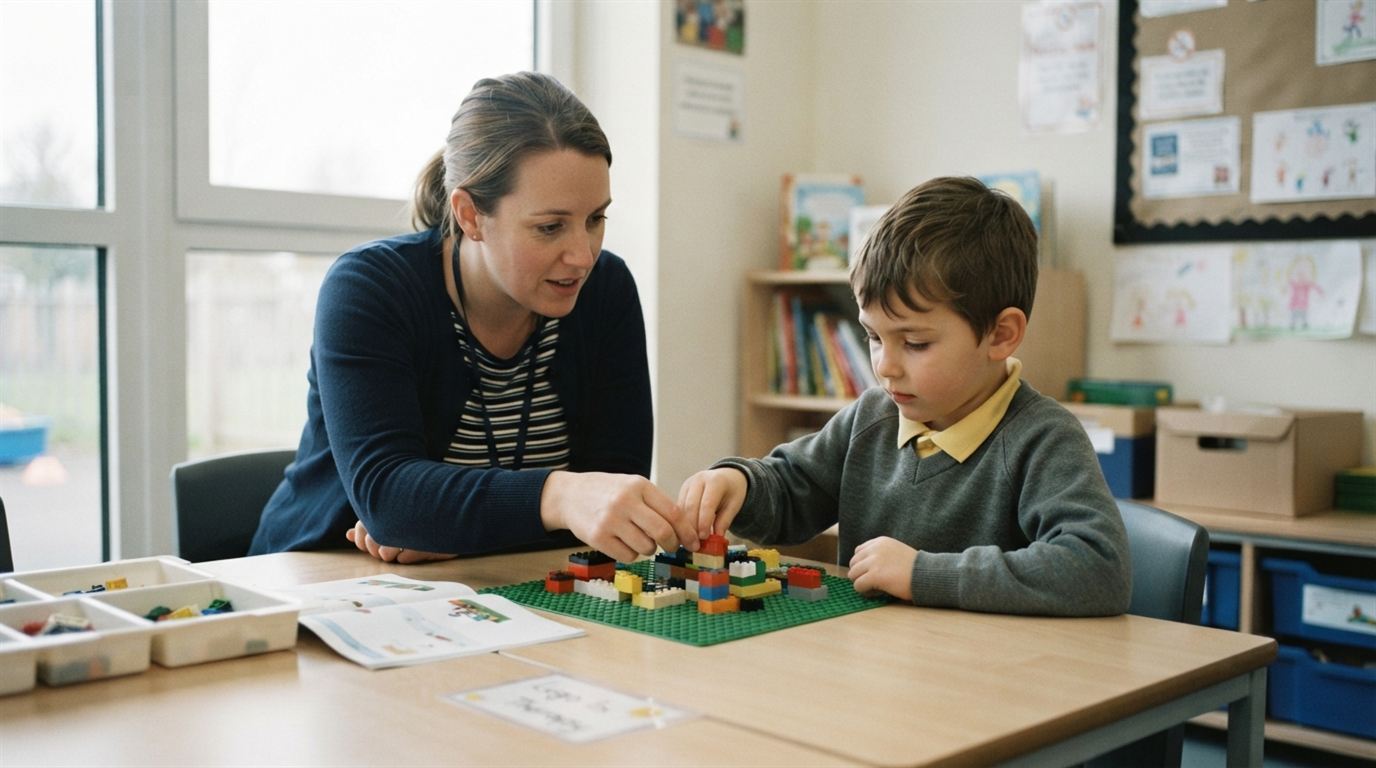
You come out of a meeting with the SENCO and your child is now doing Lego therapy on Tuesdays, sensory circuits before registration and something called ELSA. Nobody has explained what any of them are, or how anyone will know whether they’re working.
We went back to the SEN Information Reports from our October research on Kent schools and counted every support programme they name. Then we read the research on the ones that come up most.
Most of what your child is likely to be offered has never been properly tested. That doesn’t mean it won’t help. It means the useful question isn’t “which programme?” but “what is it for, and how will you check?”
The number of named programmes in a typical Kent school’s SEN report. In primary schools it is nine. In secondary schools it is three, and five secondaries name none at all.
How we counted
- The schools. The same 63 Kent schools as our October research, chosen systematically from the public list: 42 primary and 21 secondary. We had the full text of 62 reports. One primary school’s website was down when we collected them.
- What “named” means. The programme’s name appears somewhere in the report, as something the school offers, uses or has trained its staff in.
- What this can’t show. A school may run a programme without naming it, or name one it no longer runs. This is a count of what schools tell parents, read in October 2026.
- The research. For each of the most-named programmes we looked for trials and research reviews and read them at the source in November 2026. Where we say we found no trial, that is all it means: we looked, and didn’t find one.
- No school is named. The point is the pattern.
What Kent schools name most
| Programme | What it’s for | Schools naming it |
|---|---|---|
| Speech Link or Language Link | Checking and practising speech and language | 34 |
| Sensory circuits | Movement activities to get a child ready to learn | 31 |
| Lego therapy or a Lego group | Social skills | 29 |
| Zones of Regulation | Naming and managing feelings | 25 |
| Precision teaching | Daily practice of words, spellings or number facts | 24 |
| Fizzy, Clever Hands, Clever Fingers or BEAM | Movement and hand skills | 24 |
| Social stories | Preparing for a situation a child finds hard | 22 |
| ELSA | Emotional support from a trained teaching assistant | 19 |
| Drawing and Talking | One-to-one emotional support | 19 |
| Nurture group | A small group for part of the school day | 19 |
| Colourful Semantics | Building sentences | 11 |
| Any named maths programme | Catching up in maths | 9 |
Source: Education With Lauren, a count of 62 Kent schools’ SEN Information Reports collected on 20 to 24 October 2026. A school can appear in more than one row.
Feelings and friendships
This is where most of the named support sits. Fifty-five of the 62 reports name at least one programme for feelings, friendships or behaviour.
Lego therapy (29 schools). Three children build a model together, each with a job: one reads the instructions, one finds the bricks, one builds. An adult keeps them talking and taking turns. It has been properly tested. In a trial in 98 schools in the north of England, 250 autistic children aged 7 to 15 either had 12 weekly sessions or carried on with their usual support. Teachers rated the social skills of the Lego group slightly higher afterwards. The difference was small, it fell just short of the usual statistical test, and it had gone a year later. The researchers still concluded that schools should consider it, partly because it costs little to run. It was tested with autistic children. Many schools use it more widely than that.
Social stories (22). A short story written for one child about one situation they find hard, such as lining up or losing a game. A trial in 87 primary schools followed 249 autistic children. Those who had social stories met the personal goal set for them more often. There was no measurable change in their wider social skills, anxiety or mood after six months.
Zones of Regulation (25). Feelings are sorted into four colours, so a child can say “I’m in the yellow zone” and pick a strategy. It gives a class a shared way to talk about feelings, which is part of its appeal. A research review published in 2023 found very little evidence that it works, and concluded that it doesn’t yet meet the standards for an evidence-based practice.
ELSA (19). An emotional literacy support assistant is a teaching assistant trained and supervised by educational psychologists to support individual children. A 2024 review, commissioned by the ELSA Network itself, found 53 studies. Most were small and built on interviews and questionnaires about what children, parents and staff thought of it. Only one took a fully numbers-based approach. We found no controlled trial.
Drawing and Talking (19). A child draws while an adult asks gentle questions, usually for half an hour a week over 12 weeks. We found no published study of its results.
Nurture groups (19). A small group, taken out of class for part of the day, with the same adults and a settled routine. The largest study, in Northern Ireland, compared 384 children in schools with and without nurture groups. Teachers reported big improvements in the nurture group children’s behaviour and wellbeing, and none in their schoolwork. The schools weren’t chosen at random, and the teachers knew which children had attended.
Movement and the senses
Sensory circuits (31, of which 27 are primary schools). A short circuit of activities, often first thing in the morning: some to wake the body up, some for balance and co-ordination, some to calm. We found no trial of sensory circuits. A 2026 review of planned sensory activities in schools, such as movement breaks, concluded that they may help, that the research is limited, and that each child’s progress should be tracked to see whether it is working for them.
Fizzy, Clever Hands and BEAM (24 primary schools name at least one of these or Clever Fingers). These are home-grown. Fizzy and Clever Hands were written by NHS therapists in Kent, and BEAM was designed by physiotherapists in Kent. Kent’s NHS children’s therapy service recommends Fizzy and Clever Hands to schools and families for children who find movement or hand skills hard. They are practice activities, written down so that school staff can run them. We found no published evaluation of any of them.
Speech and language
Forty-three of the 62 reports name at least one speech and language programme.
Speech Link and Language Link (34). Online checks that flag children whose speech or understanding of language is behind, with ready-made activities for staff to use afterwards. One version has been through a large independent trial. Infant Language Link was tested with Year 1 classes in 166 English primary schools. Children in schools using it made no more progress in language than children in schools carrying on as usual. Staff said the screening was helpful for spotting children who needed support. Teachers also said many of the whole-class materials were similar to what they already used, which may explain the result. The trial tested that one version in one year group. It tells us nothing either way about Speech Link or the versions for older children.
Colourful Semantics (11) and Language Through Colour (10). Both colour-code the parts of a sentence (who, doing what, to what, where) to help a child build one. Colourful Semantics has a handful of small, encouraging studies, including a randomised study of 40 autistic children in Cyprus, and no large UK trial. Language Through Colour is a different scheme, named by ten of the primary schools here. We found no published evaluation of it.
The one nobody names. The early language programme with the strongest evidence is NELI, the Nuffield Early Language Intervention, for children in Reception. In a trial in 193 schools, children who received it made about three months’ more progress in spoken language than those who didn’t. None of the 62 reports names it. Schools may well be running it without saying so in a document about special educational needs. If your child is in Reception and talking is the worry, it’s worth asking.
Reading: precision teaching and coloured overlays
Precision teaching (24). A few minutes of timed practice every day on a small set of words, spellings or number facts, with the results charted so the adult can see what has stuck. The studies in schools are small and mostly positive for the narrow skill being practised. There has been no large trial. It is a way of practising, so what matters is whether the right thing is being practised.
Coloured overlays (36). Overlays appear in more reports than any named programme. In 31 of the 36 they appear in the same sentence, from a template many Kent schools share, which lists “recommended aids, such as laptops, coloured overlays, visual timetables, larger font”.
The research doesn’t support them as a way of improving reading. A review of 51 studies, published in 2016, concluded that their use for reading difficulties could not be endorsed. The better designed the study, the smaller the benefit, and the gains were often no bigger than with a placebo. A 2026 review came to the same view. The British Dyslexia Association says overlays may make reading more comfortable for some children. It also says they must not be promoted as the first strategy for a child with reading difficulties, and should not take the place of a full professional assessment of a child’s eyesight.
So if your child finds a page easier to look at through a coloured sheet, there is no harm in using one. It is a comfort, not a reading intervention. If an overlay is the only thing on offer to a child who is struggling to read, ask what else is.
Maths: the gap
Kent school reports that name a maths programme. Fifty-five name one for feelings, friendships or behaviour.
Nineteen reports mention any extra help with maths at all, even in general words such as “maths intervention” or “booster group”. Thirty-eight mention extra help with reading. The word “dyslexia” appears in 42 reports. “Dyscalculia” appears in 16.
Maths difficulties aren’t rarer than that suggests. A study of primary school children in Northern Ireland found that about 6% had persistent, severe difficulties with maths.
Tested maths programmes do exist. One of them, 1stClass@Number, has been through two independent trials with Year 2 children. Both found about two months’ extra progress. Three of the 62 reports name it.
If maths is where your child struggles, ask directly what the school offers. A report that says nothing may only mean that nobody has written it down.
What this adds up to
- Few of these programmes have been through a large trial. Of those in the table, we found large trials in English schools for four: Lego therapy, social stories, Language Link and 1stClass@Number. The results were small, partial or, for Language Link, no better than usual teaching.
- Untested is not the same as useless. Plenty of children get a great deal from an adult who knows them, a quiet room and half an hour a week. The research summary schools are pointed to says teaching assistants make the most difference when they are trained to deliver a structured programme to a small group, and much less when they are simply present in the classroom.
- Schools rarely say why they chose what they offer. Nine of the 62 reports use a phrase such as “evidence-based”. Four mention the Education Endowment Foundation, the body that tests these programmes for schools.
- Checking matters more when the evidence is thin. When we read these reports in full in October, 50 mentioned a provision map and one included figures on whether its support had worked.
- Secondary schools name far less. A typical primary report names nine programmes and a typical secondary names three.
Five questions to ask about any intervention
- What is it for? Which need is it meant to meet, and what should be different for your child at the end?
- Who runs it, and what training have they had? In the Lego therapy trial, staff had three hours of training. The researchers later said that may not have been enough.
- How often, for how long, and what will my child miss? A child taken out of maths three times a week for something else is paying a price for it.
- How will you know whether it has worked? Ask what was measured before it started and what will be measured at the end.
- When will we review it, and what happens if it hasn’t worked? The SEND Code of Practice expects schools to assess, plan, do and review, and to meet parents of children on SEN support at least three times a year.
Put the questions in an email so there is a record. Our parents’ evening guide and the free letter template on our Resources page will help, and our guide to SEN support explains what school has to do.
Frequently asked questions
What is Lego therapy?
A social skills group in which children build Lego models together in set roles, with an adult guiding how they talk and take turns. A large trial with autistic children in English schools found a small improvement in teacher-rated social skills after 12 weeks, which fell just short of the usual statistical test and had gone a year later.
What does ELSA mean at school?
Emotional literacy support assistant: a teaching assistant trained and supervised by educational psychologists to support individual children with their feelings. The research on it is mostly small studies of what children, parents and staff think. We found no controlled trial.
What are sensory circuits?
A short sequence of physical activities, usually at the start of the day, meant to help a child feel ready to learn. We found no trial of sensory circuits. A 2026 review of planned sensory activities in schools found the research limited and advised tracking each child’s progress.
Do coloured overlays help with dyslexia?
The research doesn’t support them as a way of improving reading. A 2016 review of 51 studies concluded their use for reading difficulties could not be endorsed. The British Dyslexia Association says they may make reading more comfortable for some children and must not be promoted as the first strategy.
If a programme hasn’t been tested, should I refuse it?
No. Untested doesn’t mean it won’t help your child. Ask what it is for, how the school will check whether it’s working, and when you’ll review it together.
Which schools did you look at?
Sixty-three Kent schools chosen systematically from the public list in October 2026. We haven’t named them. The point is the pattern.
Where Education With Lauren fits in
A programme helps when it fits the child. Working out what your child needs is the hard part, and it is what our assessment is for.
- Achieving & Thriving Gap Analysis. An independent picture of your child’s attainment, learning gaps, processing and barriers to learning, with indicators of SEND. It costs from £395, with a written report within 10 working days (up to 14 at busy times). It is an educational assessment, not a medical diagnosis.
- Gap Analysis with School Liaison Service. From £625 together. The report comes with practical strategies and reasonable adjustments the school can implement, and a targeted provision map written for the class teacher and SENCO to use.
No assessment can promise an outcome. What it gives you is a measured picture of your child to put in front of school, so the support is chosen for them.
Tell us what’s happening, and we’ll tell you honestly whether we can help.

Lauren is the founder of Education With Lauren, a qualified teacher and SEND specialist with 16 years’ experience across mainstream schools, Kent County Council provisions and specialist settings. She holds a BA (Hons) in Primary Education with QTS (SpLD, Needs and Inclusion) and an MSc in Neuroscience and Brain Cognition, and is an approved education supplier to Kent County Council.
This article is general information for parents. It is not medical or legal advice. School reports were read in October 2026 and may have been updated since. The research was read on 23 November 2026.
Sources
- Education With Lauren, count of named programmes in 62 Kent schools’ SEN Information Reports, collected 20 to 24 October 2026
- Wright B and others (2023), Play brick therapy to aid the social skills of children and young people with autism spectrum disorder: the I-SOCIALISE cluster RCT, Public Health Research 11(12); and Biggs K and others (2026), lessons from delivering the trial, PLoS One
- Wright B and others (2025), Autism Spectrum Social Stories in Schools Trial 2 (ASSSIST-2), Child and Adolescent Mental Health
- Mason, Leaf and Gerhardt (2023), A Research Review of the Zones of Regulation Program, The Journal of Special Education 57(4)
- Rogers and Kelly (2024), A scoping review of the literature exploring and evaluating the emotional literacy support assistant (ELSA) intervention, Emotional and Behavioural Difficulties 29(1-2)
- Sloan, Winter, Connolly and Gildea (2020), The effectiveness of Nurture Groups in improving outcomes for young children with social, emotional and behavioural difficulties in primary schools, Children and Youth Services Review 108
- Latifi, Patterson, Rider and Lau (2026), Impact of Sensory Activity Schedules on School Performance of Students With Sensory Processing Differences: A Systematic Review, American Journal of Occupational Therapy
- Kent Community Health NHS Foundation Trust, Coordination and motor development and BEAM and Jump Ahead
- Education Endowment Foundation, Infant Language Link: trial
- Christopoulou and others (2021), Colorful Semantics in Cypriot-Greek-Speaking Children with Autism Spectrum Disorder, Folia Phoniatrica et Logopaedica
- Education Endowment Foundation, Nuffield Early Language Intervention (second trial)
- Gist and Bulla (2022), A Systematic Review of Frequency Building and Precision Teaching with School-Aged Children, Journal of Behavioral Education 31(1)
- Griffiths, Taylor, Henderson and Barrett (2016), The effect of coloured overlays and lenses on reading: a systematic review of the literature, Ophthalmic and Physiological Optics 36(5)
- Flaherty, Bhate, Lea and Gole (2026), Coloured filters and lenses for reading discomfort and difficulty: an Australian and New Zealand perspective, Clinical and Experimental Optometry
- British Dyslexia Association, Visual difficulties
- Morsanyi, van Bers, McCormack and McGourty (2018), The prevalence of specific learning disorder in mathematics and comorbidity with other developmental disorders in primary school-age children, British Journal of Psychology 109(4)
- Education Endowment Foundation, 1stClass@Number 1: second trial
- Education Endowment Foundation, Teaching Assistant Interventions, Teaching and Learning Toolkit
- Department for Education, Special educational needs and disability code of practice: 0 to 25 years, paragraphs 6.44 to 6.56 and 6.65
Not sure where to start?
Tell us what you need.
We’ll tell you honestly whether we can help.
- 07943 010892
- info@withlauren.uk
- West Malling, Kent. At home, at school or in a West Malling classroom.